 Customer Service: (252) 305-5758
 Customer Service: (252) 305-5758
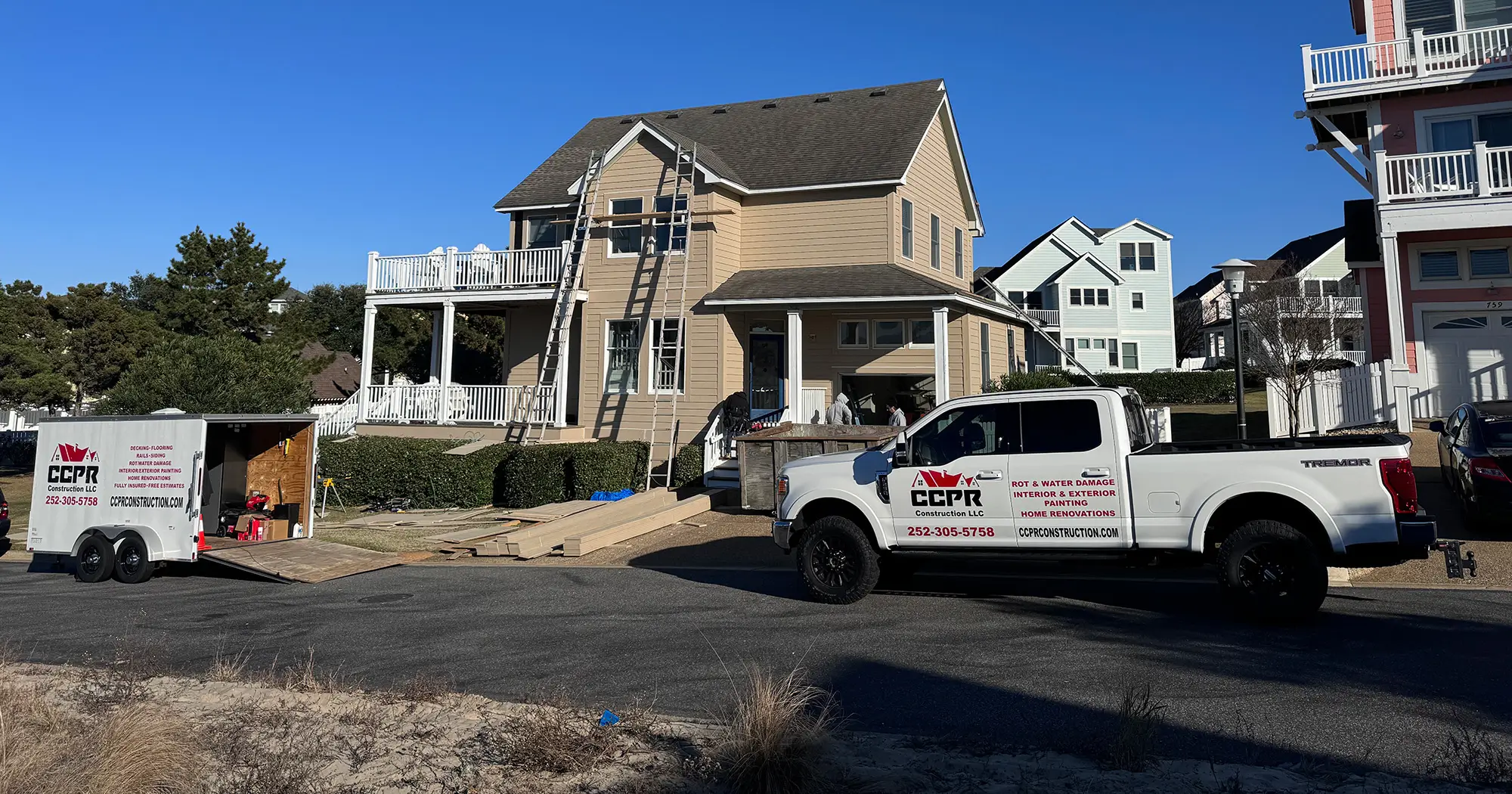
Most exterior repaints on the Outer Banks fail somewhere between year three and year five. Inland, the same product on the same kind of house can run eight to ten before it needs more than a wash. The difference isn’t the paint. It’s the air it lives in.
Salt aerosol off the Atlantic settles on every surface from Carova down to Hatteras. Summer humidity sits near 80% for weeks at a time. Direct UV is brutal out here because there are almost no trees to break it, and the dunes bounce light back at the south and east elevations of your house all day. Then in winter we get nor’easter wind-driven rain pushing water sideways into every seam. None of the big brand spec sheets are written for that combination, which is why so many homeowners end up calling us four years after a “premium” job asking why the south wall is chalking.
We’ve been painting houses on the OBX since 2007. The notes below are what we’ve actually learned about what works out here, and where most of the failures we get called to fix come from.
Any painter who’s spent real time on coastal homes will tell you the same thing in some version: a $90 gallon of paint on a poorly prepped wall fails faster than a $45 gallon on a properly prepped one. The substrate is the game.
Here’s what we do on a typical OBX repaint that a lot of crews skip.
We soft-wash before we power-wash. Power-washing alone drives salt deeper into the wood grain instead of pulling it out. We start with a low-pressure detergent rinse to dissolve the salt and the mildew, let it dwell, then rinse with fresh water. The siding has to come out visibly clean and then has to dry for at least 48 hours, longer if it’s been a humid stretch.
We scrape and feather every failing edge. Not just spot-scrape the obvious peeling — actually run a carbide scraper over every elevation looking for soft spots. Coastal homes hide failure under intact-looking paint, because the bond underneath has let go but the top film is still holding. Paint over that and you’ve bought a year, maybe two.
We spot-prime bare wood with an oil-based or shellac-based primer, not the latex topcoat we’re using for the finish. Tannin bleed from cedar and cypress, which is what most older OBX cottages are sided with, will telegraph through latex within a season. Zinsser Cover-Stain or BIN handles it. A latex primer doesn’t.
If the house was built before 1978, prep gets more involved. Federal law requires lead-safe work practices on any paid exterior project that disturbs more than 20 square feet of paint on a pre-1978 home. The EPA’s Renovation, Repair and Painting Program rules lay out exactly what that means. There are plenty of cottages in older Nags Head, Manteo, and Buxton that fall into this category. The contractor you hire needs to be EPA RRP-certified, which is a real certification with a paper trail, not something they tell you on the phone.
There’s a Sherwin-Williams Duration vs Emerald vs Benjamin Moore Aura debate that comes up on every exterior estimate, so I’ll just answer it.
For most OBX homes we use Sherwin-Williams Emerald Exterior or Benjamin Moore Aura Exterior. Both are 100% acrylic. Both have strong mildewcide packages. Both flex enough to handle the daily expansion and contraction these houses go through. We’ve seen Emerald hold its gloss a bit better, and Aura hold deep colors a bit better, but honestly either is a solid choice. On oceanfront elevations specifically, we’ll sometimes step up to an elastomeric coating like Sherwin-Williams ConFlex over stucco or fiber cement, because hairline cracking is the most common failure mode out there and elastomerics bridge those cracks instead of cracking with them.
What we won’t put on a coastal house: contractor-grade builder’s paint. The base paint that comes free with the house at closing. Anything labeled “ultra” that costs $25 a gallon at the big-box store. They don’t have the resin content to survive this environment, and you’ll be repainting in three years.
Sheen matters too. Flat hides surface imperfections but holds salt and mildew. We default to satin for the body, semi-gloss for trim and shutters, and a high-gloss for front doors. The slicker the surface, the easier it is for salt and grime to wash off in the rain. That’s not a theory, it’s what we see on five-year walkthroughs.
A lot of what makes a coastal repaint last has nothing to do with what’s in the can.
Hardware. We replace any rusted nails or screws we find during prep and use stainless or hot-dipped galvanized fasteners on any siding or trim work. A single rusty nail head will bleed through a finish coat within six months, and you’ll have a streak running down your siding for the rest of the paint’s life.
Caulk. We don’t use painter’s caulk on coastal exteriors. We use a polyurethane or hybrid sealant — Sikaflex, OSI Quad Max, or similar — at every seam where two materials meet. The latex caulk that comes standard in a painter’s truck shrinks, cracks, and lets water in. The repair shows up the next summer.
Color choice. I’ll tell clients this one straight. Dark colors fade faster, and on the OBX they also drive surface temperatures past 160°F on a summer afternoon. That heat cycle cooks the binders in the paint and pulls moisture out of the wood underneath. If you want a navy or charcoal house, that’s fine, but plan to repaint two or three years sooner than you would with a mid-tone. There’s nothing wrong with going dark, just go in with eyes open about the trade-off.
Timing. We don’t paint between mid-November and mid-March if we can avoid it. Surface temperatures drop below the manufacturer’s minimum overnight, and dew on freshly applied paint causes blushing and adhesion failure. We also don’t start a coat after about 2 pm in summer, because the evening dew arrives before the film has cured. A lot of “premium” jobs fail just because somebody rolled them out at the wrong hour.
If you’re collecting exterior repaint estimates, a few questions will tell you most of what you need to know about whether the contractor actually gets OBX conditions.
Ask what their prep process is, step by step. “Pressure wash and paint” is not a prep process.
Ask which paint they’re specifying by product name and why. “Premium exterior” isn’t an answer. Emerald, Aura, Duration, Regal Select — those are answers.
If your house is older than 1978, ask whether they’re EPA RRP-certified. If they aren’t sure what RRP means, you have your answer.
Ask what the warranty covers and what voids it. A real coastal paint warranty covers adhesion failure, peeling, and blistering for at least three years. A “warranty” that excludes anything weather-related is worth nothing out here.
I won’t pretend we got all of this right our first few years on the OBX. We didn’t. We learned a lot of these lessons the hard way, on our own jobs, before we knew what coastal exposure does to a paint film over time. That’s part of why we know what to look for now.
If you want a walk-through of your exterior, we’ll come look at it and give you a straight answer about whether it needs a full repaint, a spot repair, or another season of patience. Send us a message or give us a call and we’ll set something up. Our exterior painting services page has the full list of work we take on, and if you’re weighing a repaint against other coastal upkeep, our piece on the top renovations OBX vacation home owners make covers what tends to pair well with an exterior refresh.