Customer Service:

- Decking
The 10-Point Deck Safety Inspection We Run on OBX Rental Homes Before Memorial Day
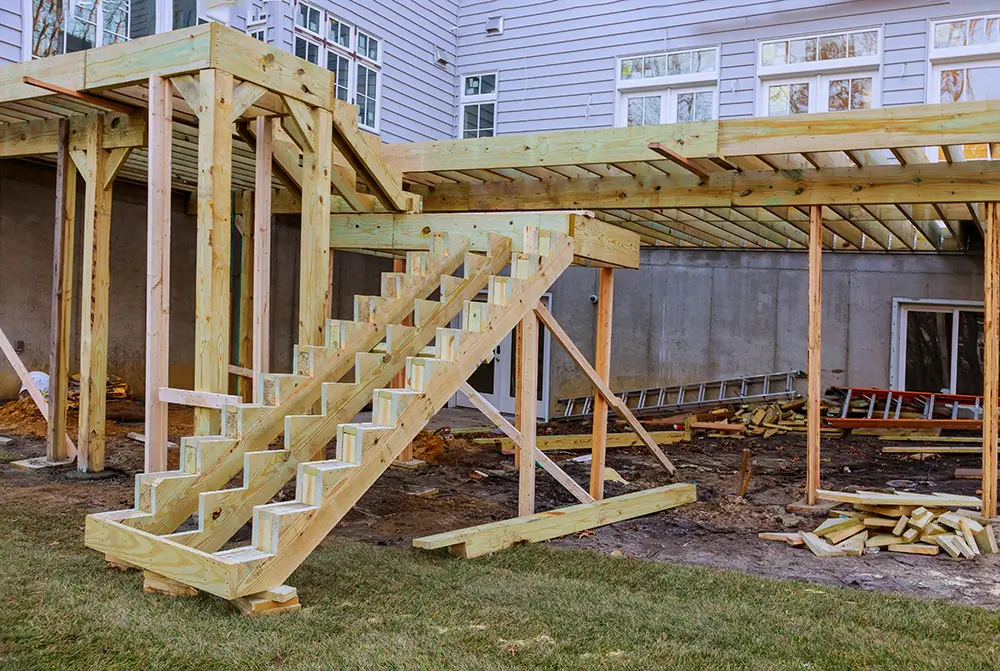
Every spring, before the first renters roll in, we go house to house doing rental deck inspections from Corolla down to Hatteras Island. We’re an Outer Banks deck builder out of Nags Head, and the routine doesn’t change much from one deck to the next. This is the order we go in:
- The ledger (the board that ties the deck to the house)
- Posts, footings, and pilings
- The joists and beams underneath
- The metal: hangers, hurricane ties, bolts, and screws
- Railings
- Stairs and the handrail
- The deck boards themselves
- Lights and outdoor outlets
- Hot tub, outdoor shower, grill
- Whatever’s going on under the deck
Some of this you can check yourself with a flashlight and a screwdriver. I’d leave the first four to somebody who looks at deck framing for a living. Those parts hold the whole thing up, and a bad connection can look fine from a few feet away.
Why rental decks need a check every spring
Think about what a rental deck goes through in one summer. A group of twelve shows up and fires up the grill. They spend the whole week out there with drinks in hand and wet towels slung over the rail. The next week a new group does it all over again. Then the house sits shut up from fall to spring while nor’easters blow rain sideways into every joint and the salt air goes to work on anything made of metal.
Most of the deck calls we get on the OBX trace back to one of two things: water that got trapped somewhere, or hardware that rusted. You can’t see much of either from the top of the deck.
There’s a legal side to this, too. Under North Carolina’s Vacation Rental Act, a landlord has to follow the building codes that apply, keep the place fit and habitable, and keep common areas safe (N.C. Gen. Stat. § 42A-31). We build decks, so for what that means for your house specifically, ask your attorney or property manager. On our end it means a wobbly railing or a cracked tread gets fixed before a guest finds it the hard way.
When to schedule a rental deck inspection
Memorial Day lands on May 31 in 2027, and that’s the weekend the rental calendar starts filling up out here. We’d rather get to your deck in February or March, early April at the latest. That leaves time to get materials in and pull a permit if the repair turns out to be structural, and the work is done before your first check-in. Late winter’s easier to schedule anyway, since the work isn’t bumping into rental season. (Winter is when most spring projects around here get lined up. We wrote about that in How Winter Impacts Home Remodeling in the Outer Banks.)
Got a property management company? Give them a heads-up. They can let us in between bookings, and they’ll often know what guests griped about last summer, like the stair that wobbles or the soft spot by the grill.
The 10 checks
1. The ledger, where the deck attaches to the house
The ledger’s the board fastened to the side of the house, and it carries one whole side of the deck. When a deck pulls away from a house, this is usually where it lets go.
So the first thing I look at is how it’s held on. You want bolts or lag screws going into the house framing. Nails by themselves won’t cut it. Then there’s the flashing over the top of the ledger, which most people never think about. Skip it and rain runs down behind the board, and now the ledger and the house’s rim joist are rotting at the same time.
Dark streaks on the siding below the deck are a bad sign. So is wood a screwdriver sinks right into, or a gap opening up between the ledger and the house. One customer told us their old deck was “literally secured by the flashing.” You’d never know that standing on it. If rot has gotten into the house framing behind the ledger, we fix that too, since water damage and rotted framing are part of what we repair anyway.
2. Posts, footings, and pilings
Posts rot from the bottom up. Sand drifts against them and holds moisture right at the ground line until the wood goes soft. We poke every post at grade and look for splits or any lean. Metal post bases can rust paper-thin out here, so those get a close look too.
A lot of raised houses out here have upper decks sitting on tall posts. Those generally need diagonal bracing, so we make sure the braces are still snug and the bolts haven’t rusted through. Get three or four people walking across the deck at once. If it sways, the bracing needs work.
3. Joists and beams
This part means crawling underneath with a screwdriver or an awl and jabbing it into the framing. Good wood pushes back. Rotted wood lets the tip sink in like it’s cork.
I pay the most attention to the joist ends and to the top edges right under the boards, because water sits there and you can’t see it. Sagging joists go on the list. So do beams somebody notched to clear a pipe, and old repairs that were never done right. If the rot is limited to a few joists, we can usually replace them or sister new ones alongside. If it runs through most of the frame, new boards on top would be money thrown away, and we’ll tell you that before you spend it.
4. Joist hangers, hurricane ties, and fasteners
Salt is rough on metal. It leaves a film on hangers, hurricane ties, post bases, and bolts that holds moisture against the steel, and today’s treated lumber is hard on fasteners on top of that. Underneath, we’re looking for rust that’s flaking or swelling and for hangers that are missing nails. Any screw or nail that was never rated for treated wood outdoors gets replaced.
Replacement hardware should be hot-dip galvanized or stainless. Close to the ocean, I’d go stainless. It’s the same salt air that makes exterior paint fail fast on the Outer Banks, and it’s chewing on your deck hardware twelve months a year.
5. Railings
I grab every railing post and shove it, in and out, about as hard as a guest would lean on it to get a better look at the water. Railings take a beating at a rental. People lean on them all week and drape towels over them to dry, and it’s usually the connection at the bottom of the post that works loose first.
Code-wise, North Carolina requires a guard on any deck surface more than 30 inches off the ground. It has to be at least 36 inches tall, and the openings have to be tight enough that a 4-inch sphere won’t fit through. Some older decks don’t meet that because they went up under an older code. On a rental full of families with little kids, that baluster spacing matters.
6. Stairs and handrails
Stairs get a lot of our attention, because stairs are where people fall. One step that’s a little taller or shorter than the rest will trip somebody, and it tends to happen at night or when they’re hauling a cooler up from the beach.
We measure the risers and check every tread for splits and soft spots. Then we get down low and look at the bottom of the stringers, where they sit on sand or a concrete pad and wick up water. Four or more risers means you need a handrail, and it has to be something you can wrap your hand around. A flat 2×6 laid on top of the rail doesn’t count. The North Carolina Residential Code sets the exact stair and handrail dimensions, and your town’s building inspector makes the call on what passes.
7. Deck boards
We walk every board. Soft spots, cracks, boards that have cupped and hold puddles, screw and nail heads that have worked their way up. Nobody wears shoes on a beach deck, so a popped nail or a splinter gets found fast, usually by somebody’s heel.
Gaps matter too. When sand and pine needles pack in between the boards, the deck can’t drain or dry out after a rain. And if the boards are shot but the frame underneath is solid, you might only need resurfacing, which means new boards and railings on the frame you already have.
8. Lighting and outdoor outlets
Your renters don’t know the house, and they’re coming back from dinner or the beach in the dark, so the stairs need to be lit. We test the stair and post lights and look for fixtures the salt has eaten up. Outdoor outlets should be GFCI-protected, with covers that close.
See an extension cord snaking under the deck boards or stapled down a railing to run the string lights? That needs a real fix. When we put in new deck lighting, we use fixtures rated for wet, salty conditions, and if a problem calls for an electrician, we’ll say so.
9. Hot tubs, outdoor showers, and grills
A hot tub full of water and people is about as heavy as anything you’ll ever put on a deck. If yours went in after the deck was built, we check whether anybody beefed up the framing under it.
Outdoor showers are on a lot of OBX houses. Get the drainage wrong and the shower soaks the framing next to it every day, all summer long, so we check around it and under it for rot. Grills get a look too, for clearance from the railing and siding and for scorched boards.
10. Everything under and around the deck
Last stop is the space under the deck. Sand piled against the posts holds moisture. So does lattice skirting with no air moving behind it, and so does the pile of beach chairs and boogie boards leaning on the posts all winter. While we’re down there we check for standing water, vines growing into the framing, and the little mud tubes that tell you termites have found the wood. Cleaning out under there costs you nothing, and the framing stays drier for it.
A deck inspection checklist for owners
If you’re down at the house this winter, spend fifteen minutes walking the deck. It’ll tell you a lot.
- Push on every railing post. If it moves at all, call us.
- Stick a screwdriver into the posts at ground level and into any joist ends you can reach.
- Check the siding under the ledger for dark stains.
- Walk the stairs slowly and notice any step that feels off.
- From below, look for rust on the hangers and bolts.
- Come back after dark and flip on the stair lights.
Only get to the house in summer? Your property manager can do this walk for you. Or we can.
What happens after the inspection
You’ll get a straight answer on what needs fixing now and what can wait until fall, with a price for each. Railings and stairs go to the top of the list along with anything structural, since those are the things that hurt people. Re-staining and other cosmetic work can usually wait until the season’s over. And if a repair isn’t worth the money, we’ll tell you.
Structural repairs usually need a permit from your town or county. Our deck FAQ covers how permits work on the Outer Banks.
Common questions
How often should a rental deck be inspected?
Once a year, before the season starts. Then again after any hurricane or nor’easter that does real damage on your stretch of beach. Hurricane season runs June 1 to November 30, so if the fall was rough, it’s worth a quick look.
Can I inspect the deck myself?
You’ll catch a lot with the walk-around above. The ledger and the framing (plus all the metal holding them together) are harder to judge, and that’s where the serious failures start, so have someone who does this for a living look at those every spring.
What if something turns up in the middle of the season?
A loose railing or a broken stair needs to be fixed, or blocked off, before the next group checks in. Smaller stuff can often be handled midweek or on turnover day. We’ll work it out with your property manager around your bookings.
Do you inspect decks you didn’t build?
Yes. It doesn’t matter who built it.
Book a spring deck inspection on the Outer Banks
We’ve been working on Outer Banks houses for more than a decade, building and fixing decks on year-round homes and vacation rentals in Dare and Currituck counties. That covers Corolla, Duck, Southern Shores, Kitty Hawk, Kill Devil Hills, Colington, Nags Head, South Nags Head, Manteo, Wanchese, and Hatteras Island. Don’t see your town? Call anyway.
CCPR Construction LLC
214 W Lost Colony Dr, Nags Head, NC 27959
(252) 305-5758
Monday to Friday, 9 AM to 5 PM; Saturday, 9 AM to 2 PM
Request a free estimate and tell us when your first booking is. We’ll plan backward from that date.

We're a Nags Head contractor building and repairing decks, siding, doors, and windows on homes from Corolla to Hatteras Island. More about us
Have A Project Like This In Mind?
Tell us what you're planning. We'll come out, look at the job, and give you a free estimate.