Customer Service:

- Decking
Trex vs. TimberTech: How Composite and PVC Decking Hold Up After 5 OBX Summers (use only after adding owner detail 2 below; until then use the fallback)
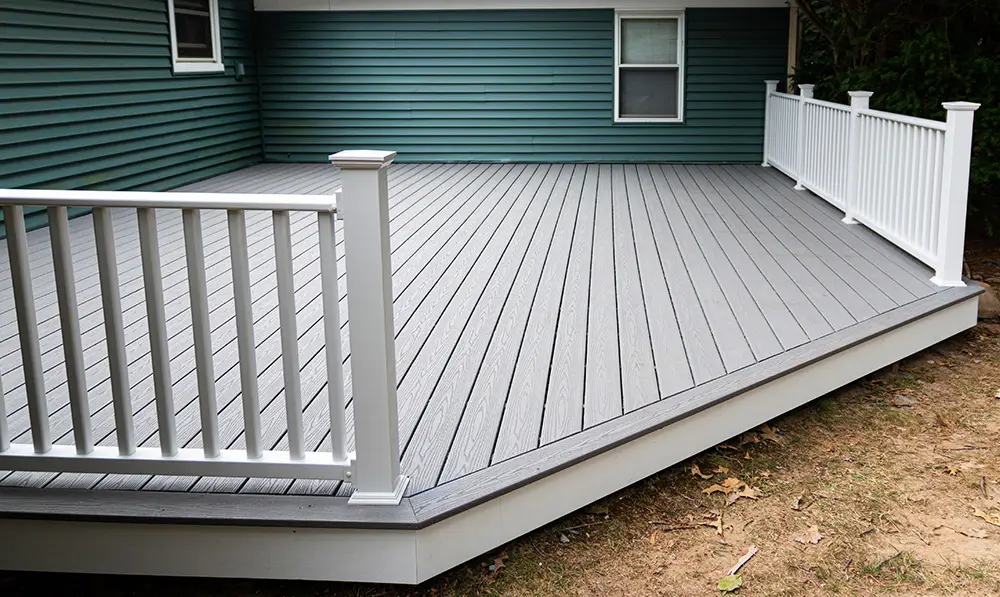
If you’re pricing a new deck on the Outer Banks, odds are you’ll end up choosing between Trex and TimberTech. As deck builders in the OBX, we install composite and PVC boards on year-round homes and rentals from Corolla to Hatteras Island, and this is the Trex vs. TimberTech rundown we’d want a customer to read first. (Still deciding whether to skip wood at all? Our deck FAQ covers wood vs. composite. This post starts after that decision.)
The short answer
Both companies make good boards. The framing and hardware underneath matter as much as whichever one you pick, though, and the bigger decision is composite versus PVC. If the deck bakes in full sun and catches salt spray all day, or stays damp underneath, I lean toward PVC, and TimberTech has far more PVC to choose from. For most rental decks and resurfacing jobs, a good capped composite from either brand will do the job for less money, as long as it goes down with stainless hardware and the right gaps.
What five summers on the Outer Banks put a deck board through
Five summers is a fair test out here. That’s five hurricane seasons of salt spray and five Julys of sun coming straight down and bouncing back up off the sand. On a rental, it’s also dozens of check-ins, with coolers and patio chairs dragged across the boards every week. Then the deck sits wet most of the winter.
Each of those works on a board in its own way. Sun fades the color and heats the surface. Salt won’t hurt the board itself, but it eats cheap fasteners and leaves a film that holds moisture. A deck in the shade that stays damp will grow mildew on the surface no matter what it’s made of, and sand under a chair leg scuffs whatever’s on top.
Composite vs. PVC: what’s in the board
A composite board is wood fiber and plastic mixed together, with a tougher plastic cap on the outside. A PVC board has no wood in it at all.
That difference shows up where water sits. On a composite, the cap is what protects the core. Trex says its newer boards, Transcend included, have a shell that wraps three sides. TimberTech caps its Legacy, Reserve, and Terrain composites on all four sides, the bottom and the grooves included, and its Prime, Prime+, and Premier boards on three. PVC has no wood core to protect in the first place. That’s why I’d pick it for a deck that never really dries out, like a low deck tucked under a raised house or one in a shady yard on the sound side.
Trex vs. TimberTech: the lineups at a glance
| Line | Material | Residential warranty | Commercial warranty |
|---|---|---|---|
| Trex Signature | Composite | 50 years | Ask Trex |
| Trex Transcend and Transcend Lineage | Composite, 3-sided shell | 50 years | 10 years |
| Trex Select | Composite | 35 years | 10 years |
| Trex Enhance | Composite | 25 years | 10 years |
| Trex Refuge | PVC | 50 years | Ask Trex |
| TimberTech Harvest, Harvest+, Landmark, Vintage | PVC | Lifetime (50-year fade and stain) | 20 years |
| TimberTech Solstice | PVC | Lifetime (35-year fade and stain) | 20 years |
| TimberTech Legacy, Reserve, Terrain | Composite, 4-sided cap | 30 years | 10 years |
| TimberTech Prime+, Prime, Premier | Composite, 3-sided cap | 25 years | 10 years |
These come from each company’s published warranties and product pages, and they change, so check the current documents before you buy. TimberTech is easy to find around here, too. The Decks & Docks yard in Powells Point calls it their most popular product.
Trex is mostly a composite company. Its one PVC board, Refuge, came out in January 2026, first in fire-prone regions and then in the Northeast, so ask your supplier whether you can get it on the Outer Banks yet.
The warranty fine print rental owners should read
Both warranties are written with homeowners in mind. Neither one mentions vacation rentals. The two companies also define “residential” differently, which matters on the Outer Banks, where so many decks belong to rentals.
Trex counts it as residential when the boards are installed on an individual residence. TimberTech goes by who bought them: a residential purchaser is “a single-family residential homeowner,” and anybody else is commercial. Commercial coverage is a lot shorter, 10 years on composite from either company, and 20 years instead of lifetime on TimberTech PVC. So if your rental is owned by an LLC or a group of partners, ask the manufacturer how they’d classify you before you choose a board. You can read TimberTech’s terms on TimberTech’s warranty page; Trex’s are on trex.com.
A few other lines in the fine print are worth knowing out here:
- Hurricanes and flooding aren’t covered by either company. Both list them as acts of God, so storm damage is an insurance question.
- Both fade warranties use the same yardstick, a color change of more than 5 Delta E units, which is a lab measurement of color shift. Trex’s document loosens that to 15 units after year 25.
- Food and drink stains are only covered if they’re cleaned off within a week. Trex’s stain coverage also includes mold and mildew cleaned within a week of showing up, while TimberTech lists mold and mildew as an exclusion. On a rental, somebody has to be looking at the deck between guests.
- TimberTech excludes heat damage, and it names reflected sunlight specifically. Trex excludes damage from heat sources over 275°F. It’s worth noticing which windows face the deck.
Heat: what bare feet will notice
Every deck board gets hot in July. Dark ones get hotter, and TimberTech says as much in its own materials. Both companies now sell boards they say run cooler. TimberTech says select colors of its Advanced PVC are up to 30 degrees cooler than competing composite, and Trex says its heat-mitigating boards (Transcend Lineage and some Enhance colors) build up as much as 35°F less heat than its original boards. Those are the manufacturers’ numbers from their own testing.
My advice to rental owners is simpler: pick a lighter color, especially around a pool or hot tub. It’s the same reason we steer people away from dark exterior paint on the Outer Banks.
Salt air, gaps, and the install details that decide how it holds up
The boards don’t rust. The screws and clips holding them down do. TimberTech’s install guides suggest 316 stainless fasteners for saltwater coastal jobs. Trex calls for stainless screws near saltwater, and its own instructions say its color-matched composite screw isn’t recommended for salt environments. On the Outer Banks, every deck counts as near saltwater. The fasteners matter for the warranty, too: Trex says problems caused by non-recommended fasteners aren’t covered, and TimberTech’s warranties don’t cover fasteners it didn’t supply.
Gapping is the other big one. Composite and PVC both grow and shrink with temperature, so the gaps between boards have to leave room for that. TimberTech’s PVC instructions warn that boards installed in full sun will change length, and they tell installers to fasten each board soon after cutting it. When the gaps are wrong, you get open butt joints or boards pushing against each other, and TimberTech lists improper gapping as a warranty exclusion.
All of it sits on a wood frame. Before new boards go down, we check the joists, beams, and ledger, the same as we would on any resurfacing job.
Which one we’d pick for your deck
For an oceanfront deck that gets sun from morning to evening, I’d go with PVC in a light color, held down with 316 stainless hidden fasteners. TimberTech’s Advanced PVC collections give you the most colors to choose from.
A low deck under a raised house, or a shady deck on the sound side that stays damp, is another good spot for PVC. A composite capped on all four sides, like TimberTech’s Legacy, Reserve, or Terrain, is the next best thing.
If it’s a rental resurfacing on a solid frame and the budget’s tight, a mid-range capped composite from either brand makes sense. Trex Select and TimberTech’s Prime+ are both in that range.
Around a pool or hot tub, go with the lightest color you can live with and ask about the heat-mitigating options from both companies.
Common questions
Does Trex make PVC decking?
Yes, as of 2026. Trex Refuge is a PVC board that launched that year for areas with stricter fire-safety requirements and then spread to the Northeast. Everything else in the current Trex lineup is composite.
Is composite or PVC better near the ocean?
Both hold up to salt air when they’re installed with stainless hardware and the right gaps. PVC has the edge on decks that stay wet or sit in full sun all day, and it usually costs more.
Will a vacation rental void my deck warranty?
Neither company’s warranty mentions rentals. Trex ties residential coverage to the boards being installed on an individual residence, and TimberTech ties it to the buyer being a single-family residential homeowner. If a business owns the house, ask before you buy.
How should I clean composite or PVC decking at the beach?
Rinse the salt and sand off with a hose, then scrub with soapy water and a soft brush. Do it often enough that a spill or a patch of mildew never sits longer than a week, since that’s the window the warranties give you.
Get both brands priced for your deck
We build and resurface composite and PVC decks in Dare and Currituck counties: Corolla, Duck, Southern Shores, Kitty Hawk, Kill Devil Hills, Colington, Nags Head, South Nags Head, Manteo, Wanchese, and Hatteras Island. If you can’t decide, we’ll price both so you can compare.
CCPR Construction LLC
214 W Lost Colony Dr, Nags Head, NC 27959
(252) 305-5758
Monday to Friday, 9 AM to 5 PM; Saturday, 9 AM to 2 PM
Request a free estimate and tell us where the deck is and how much sun it gets.

We're a Nags Head contractor building and repairing decks, siding, doors, and windows on homes from Corolla to Hatteras Island. More about us
Have A Project Like This In Mind?
Tell us what you're planning. We'll come out, look at the job, and give you a free estimate.